January 1st, 2026
The Revival of the Diamond Honeycomb - Brigade Pioneer VS Rolex Explorer Ref. 6350
There’s a kind of quiet drama to a true tool watch. Not the “look at me” kind. The “I need to know the time” kind.
Picture an era when a wristwatch wasn’t expected to be a tiny status symbol. A real tool watch doesn’t beg for attention. It earns trust. It’s the watch you forget you’re wearing—until you need it. When your hands are cold. When the light is bad. When you bump it on a doorframe. When you wash your hands without thinking. In the early 1950s, that wasn’t a vibe. It was the job description.
That’s the world the Rolex Explorer came from, and it’s the world the Explorer 6350 “Honeycomb/Waffle” still represents so clearly. It's a simple, legible watch built with purpose—plus one special dial texture that collectors still talk about. Our upcoming Pioneer watch draws on this for inspiration. A watch focused on simplicity and legibility but adapted for modern sensibilities.


- Brief Rolex Explorer History
- Brigade Pioneer Black Diamond Similarities to the Rolex Explorer Ref. 6350
- Brigade Pioneer Black Diamond Differences to the Rolex Explorer Ref. 6350
- Conclusion:
Table of Content
Brief Rolex Explorer History
Early Explorer history can feel like a messy family tree. Part of that is because Rolex didn’t build “the Explorer” as one single sudden invention. It evolved from a cluster of rugged Oyster watches that were already pursuing the same goals of clarity, toughness, and reliability. In fact, the Explorer branding only became consistent with the Rolex Explorer Ref. 6350. Models like the Rolex Oyster Perpetual Refs. 6098, 6298, and 6530 were often considered “Pre-Explorers” by collectors due to their adherence to the Explorer’s fundamentals of simple dial designs, robust oyster case, and the simplicity of only being a time-only watch. It’s a reminder: lineage isn’t a single straight line. It’s a cluster of experiments, overlaps, and small evolutions that gradually lock into the Explorer identity.
Most serious historians put the real “birth zone” of the Explorer in the early 1950s, when Rolex was refining a simple formula:
- A black dial built for speed-reading
- Bold 3-6-9 numerals
- A tough Oyster Case
- A no-nonsense three-hand layout
Two references are central here: 6150 and 6350, both introduced around 1953, with collectors debating which one deserves the “first true Explorer” crown.
The debate usually comes down to one blunt detail: the name on the dial. Many 6150 dials read “Precision,” while later examples may say “Explorer.” By contrast, the 6350 is widely described as the point where “Explorer” becomes consistent on the dial — the model that looks, reads, and announces itself as the Explorer in a way people recognize instantly today. If you like to read and learn more about the history of the Rolex Explorer, read our logbook “A Comprehensive History of the Rolex Explorer”.

Rolex Ref. 6150

Rolex Ref. 6350
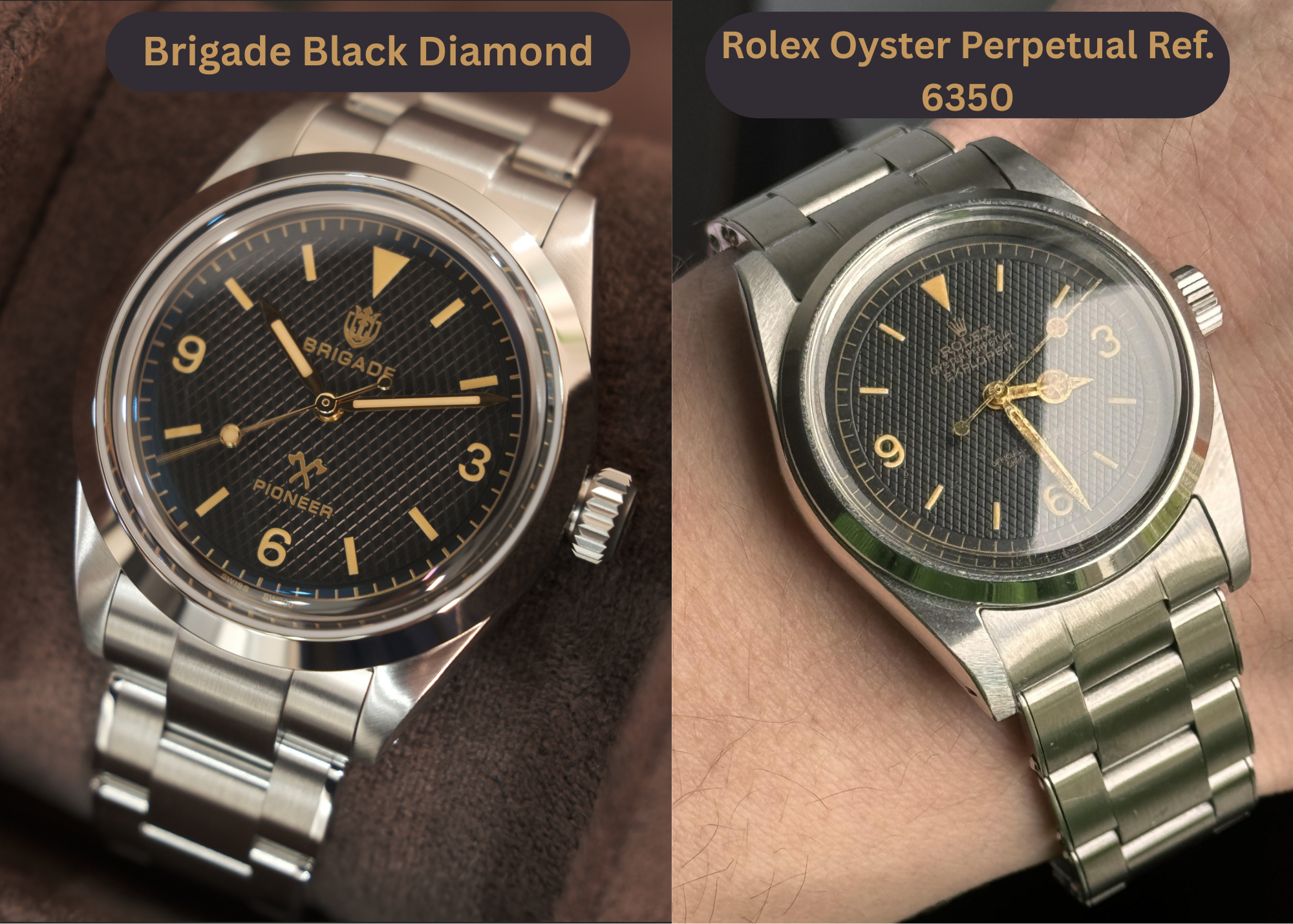
The Explorer 6350 isn’t just early — it’s defining. Even modern overviews highlight it as a key reference, and many collectors argue it’s the first proper Explorer. But the version that really grabs attention is the version nicknamed “waffle” or “honeycomb.” Collectors love the simple texture change from the traditional smooth dial. A flat dial looks the same all day. A honeycomb dial has depth; it shifts as you move. Beyond looks, it provides functional advantages as well. It has enhanced readability thanks to glare diffusion, a smooth dial reflects light strongly (specular reflection) while the honeycomb pattern diffuses light across many tiny facets, minimizing severe glare and making hands and markers easier to read quickly without excessive wrist tilting. It has increased contrast: The texture creates a micro-landscape with valleys that catch shadows, defining the peaks and creating sharp visual separation between the dial and applied luminous markers and hands. This improves legibility, especially at oblique angles. Finally, it reduces visual fatigue with the subtle 3D nature acting as a focal anchor, preventing the dial from looking flat. This reduces the visual effort needed to orient the hands, offering a more immediate perception of depth and position. It’s still a tool watch, but with more boldness from the diamond-shaped patterns. Inspired by this pattern, we decided to make the Brigade Pioneer Black Diamond. The Brigade Pioneer Black Diamond pays homage and honor to the original Rolex Explorer, but with some modern upgrades and touches that make it competitively viable in the modern watch market.

Brigade Pioneer Black Diamond Similarities to the Rolex Explorer Ref. 6350
Same Dial Pattern and Texture
Like we’ve stated before, the 6350 honeycomb/waffle dial is a collector landmark. It's specific to that Rolex reference’s identity. It's important to note that it wasn't the only Rolex model to have that diamond honeycomb dial (certain models of Rolex Turn-O-Graph Ref. 6202 and Rolex Submariner 6204 have it too), but it is the reference that most people think of when you mention the Rolex honeycomb/waffle dial. The original vintage Rolex honeycomb dial design largely died out by the late 1950s or early 1960s. Rolex transitioned away from these complex, textured dials to more standard glossy black dials with gilt text in the mid-1950s, and then to matte dials with white text in the mid-1960s.
To honor the lost dial design and to accurately pay respect to the Rolex Explorer Ref. 6350, it only made sense that we followed the same diamond honeycomb/waffle design on our dial. We wanted everyone to have a chance to experience this unique design. Therefore we made sure that people who wanted a watch like the Rolex Explorer Ref. 6350, can experience it through our Brigade Pioneer Black Diamond watch.


Patina Coloring Lume
Patina on a watch is the natural, unique aging process that changes a watch's appearance over time, creating desirable character from materials reacting to UV light, humidity, air, and wear, leading to faded dials (like black turning brown) or aged lume (white to creamy yellow/orange). Vintage 6350 dials are from an era where luminous material naturally ages. That aging is a big part of why vintage Explorers feel alive to collectors — the watch shows time, not just tells time.
The Pioneer Black Diamond’s hands, text, and logos use a creamy yellow/orange patina color to echo that visual warmth and wear on the vintage 6350 if you were to buy it today.
In the community patina-tone is popular because it gives the “earned” look immediately — the warmth people associate with well-kept vintage. The key is that it’s not pretending to be old. It’s signaling respect for how old tools age, because that visual language is part of what people love about early Explorers.

Brigade Pioneer Black Diamond Differences to the Rolex Explorer Ref. 6350
Crystal Material and Shape
In the early Explorer era, acrylic/plexiglass (“plexi”) crystals were the norm across tool watches. Watch histories commonly describe the Explorer’s evolution as a shift from acrylic to sapphire in the late 1980s modernization era (for example, the Explorer ref. 14270 era is frequently cited as the point where sapphire replaces acrylic).
That’s why the Explorer 6350’s “single domed plexi” identity makes sense in context: plexi was the tough, workable material of the time. It can look warm and vintage, and it can often be polished—but it is easier to scratch in everyday life. On the mineral-based Mohs hardness scale, plexiglass has a relatively low hardness of approximately 3 out of 10, meaning it is susceptible to scratches from harder materials. It’s also not really tough meaning it's easy to shatter.
The Pioneer Black Diamond’s sapphire crystal meets the modern durability standard. Rolex itself specifies sapphire on the current Explorer, and sapphire is chosen in modern watchmaking because it’s substantially more scratch-resistant than acrylic. On the mineral-based Mohs hardness scale, sapphire has a relatively high hardness of approximately 9 out of 10, meaning it is much harder to scratch by other minerals. Sapphire is also relatively tough, meaning it's much harder to shatter than plexiglass and diamonds, making it much harder to break during everyday activities.

The Rolex Explorer Ref. 6350 uses a single dome crystal shape which magnifies the dial and spreads impact force over a larger area, making it structurally stronger and less likely to shatter. The Brigade Pioneer Black Diamond takes this even further with the double dome crystal shape which disperses impact even better and virtually eliminates the edge distortion seen in single-domed crystals. The Pioneer’s double dome keeps some of the old “vintage curvature” feeling, but in a modern, harder material class. That curvature does something important on a textured dial: it changes how light bends and moves across the honeycomb pattern. It can make the dial feel more “alive” as you tilt your wrist—without changing the dial itself.
If you want to read more about watch crystals read our logbook called "The Watch Crystal and the Crystal Clear Truth Behind Them".


See how there is a visual distorion when viewing the Rolex Ref. 6350's single dome crystal (image on the left) compared to the more clear view you get from the Brigade Pioneer Black Diamond's Double Dome Crystal (image on the right).
Text and Logo
The 6350 comes from a time when Rolex dials were largely about clean printing and strong contrast. Printed text is simple, sharp, and very of the era, but it often seems flat or distorted on a textured dial.
The Pioneer Black Diamond uses built-inlay (3D) text and logo, which changes what your eye experiences. In purely technical terms, raised/inlay elements create physical separation between the dial surface and the information on top of it. That separation can help legibility in angled light because shadows and highlights define edges.
In watch-community terms, applied/inlay details are often read as a sign of higher-effort dial execution. Not better because it’s expensive, but better because it takes more steps to do it cleanly.

See how you can still see the diamond pattern on the markings on the Rolex 6350, especially on the logo and the text. This is because the markings were painted on and you see how that's different on the Brigade Black Diamond where every marking is lifted above the dial.
Crown
On a watch, the crown is one of the most likely places for water and dust to try to enter. It’s also the part you physically touch to wind or set time. So crown design is always a balancing act between three things:
- Grip (Can you grab it easily?)
- Comfort (Does it poke you all day?)
- Sealing (How well does it protect the case?)
The Rolex Explorer Ref 6350 has a 8 mm crown. An 8mm crown makes sense on a 1950s tool watch: more surface area is easier to grip, especially when fingers are cold or gloves are involved. Bigger crowns also give you more leverage when winding—like using a larger knob on a stiff door.
In comparison, the Brigade Pioneer Black Diamond has a slightly smaller crown at 7 mm. This size is still ample for an easy grip, but it's far less likely to dig into your wrist. Crown sizing is a trade-off between grip and comfort. Bigger crowns can be easier to manipulate, especially with gloves. Smaller crowns can feel less intrusive on the wrist during long wear.
Bracelet
The 6350 is commonly seen on an era-correct rivet Oyster bracelet, the kind collectors love because it instantly reads 1950s tool Rolex.
The Pioneer uses a diver extension bracelet with tool-free incremental adjustment. Tool-free micro-adjust systems let you change bracelet length without tools in small steps. That matters because wrists change size throughout the day (heat, activity, hydration, cold). It also allows you some flexibility when ordering something a watch that fits your wrist size.
Rolex’s own Glidelock description (on the official Rolex site for dive-watch features) explains this concept clearly: it’s a rack system that allows the bracelet to be adjusted without tools, in small increments, designed to make fitting over a wetsuit (and day-to-day fit changes) easier. However they've decided to not use this type of bracelet for their Rolex Explorers.

Size an Lug Span
The 6350 is part of the classic Explorer dial sizing tradition of 36mm. Rolex’s current Explorer references 124270 and 124273 are explicitly 36mm on the official Rolex site as well. The lug-to-lug size on the 6350 is 44mm, making it feel slightly longer than you might expect from the diameter alone. That longer span is one reason vintage Explorers can feel surprisingly present despite the smaller width. Then the modern Explorer 124270 / 124273 returns to 36mm as well, but with a slightly shorter lug-to-lug (often measured around 43mm). In plain terms, that usually makes the modern watch wear a little more contained front-to-back, even though the diameter number looks the same on paper. The case geometry has been refined to sit more neatly, as modern manufacturing tightened the silhouette.
For the Brigade Pioneer Black Diamond, the dial is 39.5mm (9–3) and 45.5mm lug-to-lug. Its 39.5mm diameter increases the dial’s reading surface, which changes the experience in a way most people can feel immediately: the time is easier to grab with a quick glance, because the different designs have more room to breathe. That can matter even more on a textured dial, where you want depth without visual clutter. To match the proportions of the Rolex Explorer Ref 6350 to truly replicate, the lug-to-lug size would naturally increase as well.
Lug Shape
The lug shape is one of the main reasons two watches with similar diameter can wear totally differently. On the Explorer 6350, the case and lugs reflect mid-century tool-watch geometry: straighter lines, chunkier transitions, and a more squared-off look. That boxiness isn’t a flaw—it’s a period design language that reads tough and utilitarian.
When the Pioneer Black Diamond is described as less boxy at the lugs, the practical meaning is this: the transition from case to lug is smoother and less block-like, which typically affects three real things people notice in daily wear. First, it can make the watch feel less like it’s “standing off” the wrist, especially when your wrist bends. Second, it can reduce sharp edges that catch on sleeves or feel bulky at the edges of the case. Third, it can make the watch look more continuous and intentional from the side profile, which is often perceived as more refined—without changing the tool-watch purpose.
So the central idea isn’t “old bad, new good.” It’s: the Pioneer keeps the Explorer tool silhouette, but cleans up the lug geometry to improve how the case sits and moves on the wrist.

Caseback
A display caseback doesn’t exist to make a watch “more waterproof” or “more accurate.” It exists to change the relationship between the wearer and the object. Traditional Explorer-style watches are historically closed and sealed. That closed back reinforces the tool-watch identity: functional, protected, nothing extra.
The Brigade Pioneer Black Diamond has a clear purple caseback. A clear caseback is sought-after today mainly because modern mechanical-watch culture values seeing the mechanism. Enthusiasts enjoy watching the moving parts—because it makes the watch feel less like a sealed product and more like a working machine. It’s also a way to show finishing and motion that you otherwise never get to experience while wearing the watch.
The purple tint adds a distinct signature to that experience, which matters because display casebacks are common across the industry. A subtle color treatment makes it recognizable and intentional, while leaving the front of the watch—where the 6350 homage lives—focused on the vintage language.

Water Resistance
Water resistance is one of the few specs where the meaning is straightforward: a higher rating gives more protection against water exposure in real life. Vintage Explorer-era pieces like the 6350 are generally understood to have had much lower water resistance than modern watches—often discussed around the ~50m range—because sealing tech, gaskets, and testing standards were different at the time. Modern Explorers are rated to 100m, which is already strong for everyday use.
The Brigade Pioneer Black Diamond has a 200m water resistant rating. A 200m rating increases the safety margin further. Practically, this matters less for deep diving and more for normal situations: repeated contact with water, higher-pressure splashes, swimming, and accidents. It also signals a more robust sealing approach overall (case, crown, gaskets), because reaching 200m typically requires tighter control of the full system, not just one part.
The Pioneer’s 200m rating isn’t about pretending everyone is a diver. It’s about giving the watch more forgiveness in daily life—more confidence that water won’t be the thing that ends the day.

Conclusion:
The Explorer 6350 honeycomb is special because it shows restraint. It doesn’t try to impress you with complexity. It tries to stay readable, tough, and calm. Then slip in that honeycomb texture and you have something special.
The Pioneer Black Diamond keeps that signature pattern intact, and then builds around it with modern choices that are easy to explain and easy to feel: sapphire instead of plexi, a double dome instead of a modern flat presentation, higher water resistance, modern fit adjustment, and a caseback that speaks to today’s mechanical-watch culture.
A tool watch, in the end, is a promise. The 6350 made that promise in the language of its time. The modern Explorer keeps it in the language of today. And the Pioneer’s job is to keep the honeycomb chapter alive—not as a safe queen, but as something you can actually live with.