


September 15th, 2026
A Brief Look at the Watches of the US Coast Guard
by Alex Y
The 25th anniversary of the terror attacks that took place on 11 September 2001 just passed. Nearly 3000 civilians were killed on that day and writing around this anniversary was always going to be tricky. However, when reading up on the attack, I learned that the United States Coast Guard had coordinated the largest maritime evacuation in recorded history in less than 8 hours. Since all bridges and tunnels to Manhattan were closed following the attacks, more than 500,000 people needed to be evacuated off of the island using any marine vehicle they could muster. That equates to a rate of just over 1000 people per minute. And if that is not enough context, imagine having to empty the stadiums/arenas of the New York Giants/Jets, Yankees, Mets, Knicks, Nets, Rangers, Islanders, and Devils, simultaneously and then double it. I was reminded that the oft forgotten Coast Guard is an important branch of our nation’s military that lived up to their motto "Semper Paratus" (Always Ready). We spend a lot of time fawning over the watches of the Army, Navy, and Air Force so they must have interesting watches too, right?

Image Credit: US Coast Guard Foundation
- Introduction
- Brief History of the Coast Guard
- Commercial Off-the-Shelf (COTS) Dive Watches
- Modern Day Digital and Smartwatches
- Conclusion
Table of Contents
Brief History of the Coast Guard

U.S. Revenue Cutter Bear, circa 1890, on patrol off Alaska.
Painting by James A. Mitchell, III
Image Credit: United States Coast Guard - U.S. Coast Guard History
The United States Coast Guard (USCG) started as the United States Revenue Cutter Service, founded in 1790. It was later merged with the United States Life-Saving Service to become the Coast Guard in 1915. Beyond its military duties, the Coast Guard serves a unique role in safeguarding maritime borders, maintaining safe and secure flow of commerce, and responding to critical emergency situations. Throughout its history, precise timekeeping has been vital for navigation, mission timing, surface warfare, diving operations, and maritime aviation. In its early years, it is likely that timekeeping relied on heavy brass bulkhead deck clocks and pocket chronometers from makers like Chelsea, Waltham, Elgin, and Hamilton.

Coast Guard rescue cutters at Poole, England before the D-Day invasion
Image Credit: National Coast Guard Museum - Jack Hamlin
Boatswain, rescue swimmer, and savior of D-Day
During World War II, when the Coast Guard was transferred to the Department of the Navy, timepieces were standardized. Specialized equipment coming out of this time included USN BuShips "Canteen" dive watches produced by Hamilton and Elgin for explosive ordnance disposal and underwater inspections, as well as Hamilton Model 21 and Model 22 chronometers. As military specifications evolved during the Cold War, personnel were equipped with MIL-W-3818 field watches and Benrus Type I and Type II dive watches (MIL-W-50717) for high-risk diving and strike team operations. These watches were not unique to the Coast Guard.
Commercial Off-the-Shelf (COTS) Dive Watches

Doxa 300T Sharkhuunter and Seiko 6309 from OPERATION SEABEES KNOWLEDGE Facebook Group
Image Credit: Huckberry - A Closer Look at What Military Members—Both Past and Present—Actually Wear On Their Wrists
By the 1970s, the allowance of commercial off-the-shelf (COTS) dive watches like the Doxa Sub 300T—favored for its high-visibility orange dial—and especially the Seiko 6309 were also adopted for surf station crews and deep water rescue operations. As the watch industry faced its quartz crisis, the Coast Guard entered a new operational era in 1984 with the establishment of its elite Aviation Survival Technician (AST) program—commonly known as Rescue Swimmers. Operating in violent seas, night storms, and freezing temperatures, rescue swimmers required hyper-durable and highly legible timepieces. And following both of these developments in the late 1990s and 2000s, the Casio G-Shock (such as the DW-5600, DW-6900, and Gulfman) became the unofficial fleet standard for general shipboard duty, flight crews, and small boat operators due to its shock resistance and digital timing utilities.
Modern Day Digital and Smartwatches

Casio G-Shock "Men in Rescue Orange" Pack
Image Credit: Hypebeast
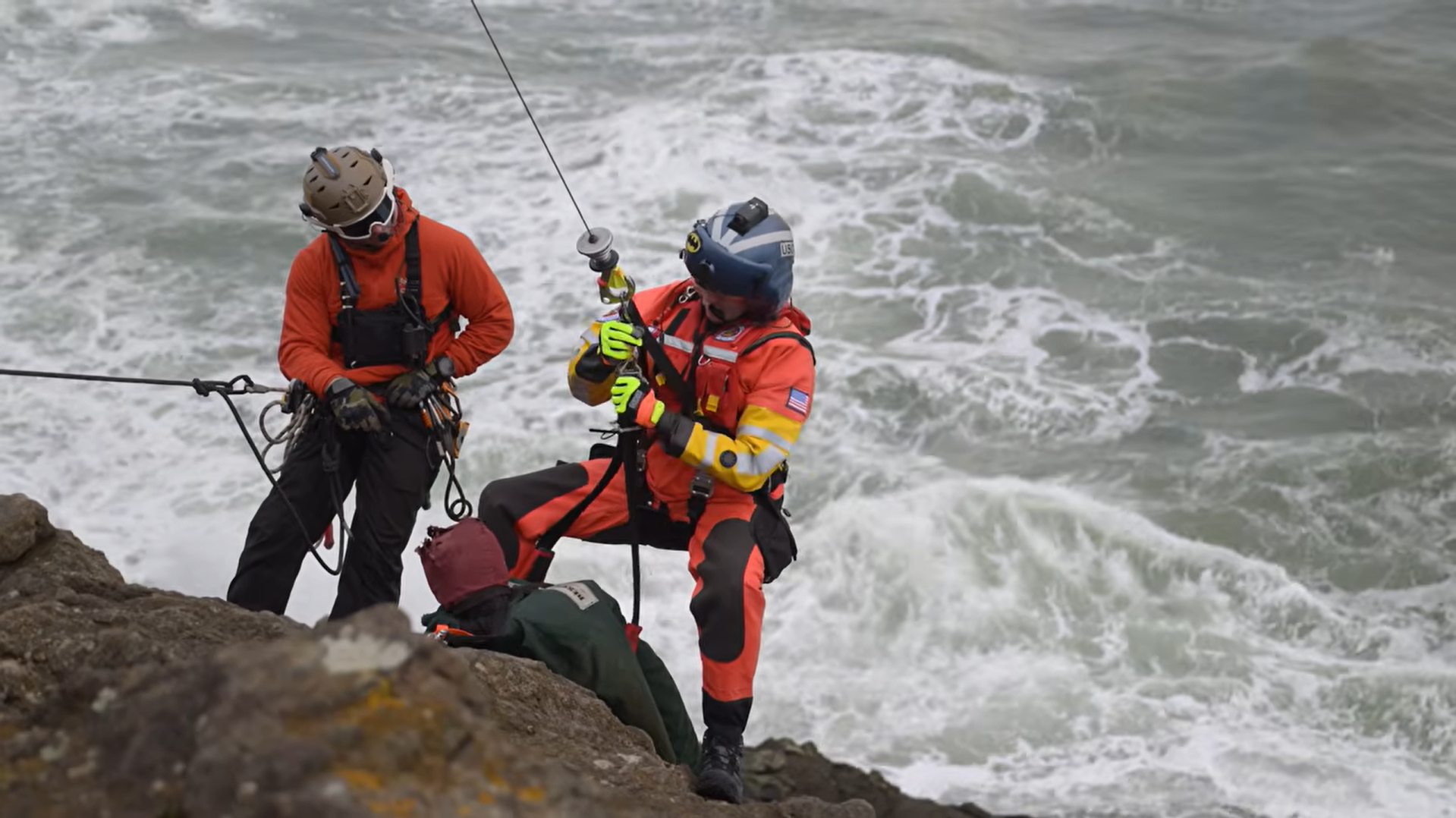
The pattern across the decades is that the Coast Guard has always stayed on the cutting edge with their watches regardless which department they have been associated with. This continues to this day with the adoption of Garmin Fenix as the tool of choice. Watches of Espionage has an excellent article on the subject as it was seen on the wrist of Rescue Swimmer Scott Ruskin after his heroic efforts saving lives after the events at Camp Mystic. Building on that, according to the United States Coast Guard news, at least 54 people have been rescued thanks to the Garmin systems in 2026 and highergov.com shows US Coast Guard Maritime Security Response Team, MRST West procuring Garmin Fenix 8 watches, suggesting its use will continue at least in the near future.

Garmin Fenix on the wrist during training
Image Credit: Youtube - The Coast Guard's elite rescue training
Conclusion

Image Credit: US Coast Guard Foundation
Looking back on the attack, it would also significantly change the Coast Guard with the later creation of the Department of Homeland Security, which the Coast Guard would eventually be transferred to in 2003. For a job that is so heavily focused saving lives, having the right tools is everything. The evolution from mechanical dive watches, to digital quartz, and now smartwatches shows a commitment to function above all else. If there comes a day when mine or my loved ones lives depend on the US Coast Guard, I will be assured they have the best tool on their wrist to save the day.
People Also Read
A Brief Look at the Watches of the US Coast Guard
On 11 September 2001, the United States Coast Guard coordinated the largest maritime evacuation in recorded history, evacuating more than 500,000 people in less than 8 hours. That equates to a rate of just over 1000 people per minute. The oft forgotten Coast Guard lived up to their motto "Semper Paratus" (Always Ready). We spend a lot of time fawning over the watches of the Army, Navy, and Air Force so they must have interesting watches too, right?
Accutron Tuning Fork: The Middle Child Between Mechanical and Quartz
Accutron's tuning fork movement. Not mechanical, not quartz, but an underappreciated innovation that bridged the gap. Let's explore the brief reign of the middle child movement.
The First Waterproof Wristwatch was American? The Depollier Field & Marine
Wait, wasn’t Rolex the first company to produce a waterproof wristwatch with its Oyster case? Evidently not. In 1918, around 8 years before the introduction of Rolex’s Oyster case, Depollier introduced the Field & Marine watch case which was advertised as waterproof and dustproof and some of which were powered by Waltham.